Following the disastrous end to his marriage to Jennie, Francis was looking for something exciting to fill the void. In September 1891, Francis left Sydney on board the steamer Waroonga, bound for the warm, tropical climate of the New Hebrides.
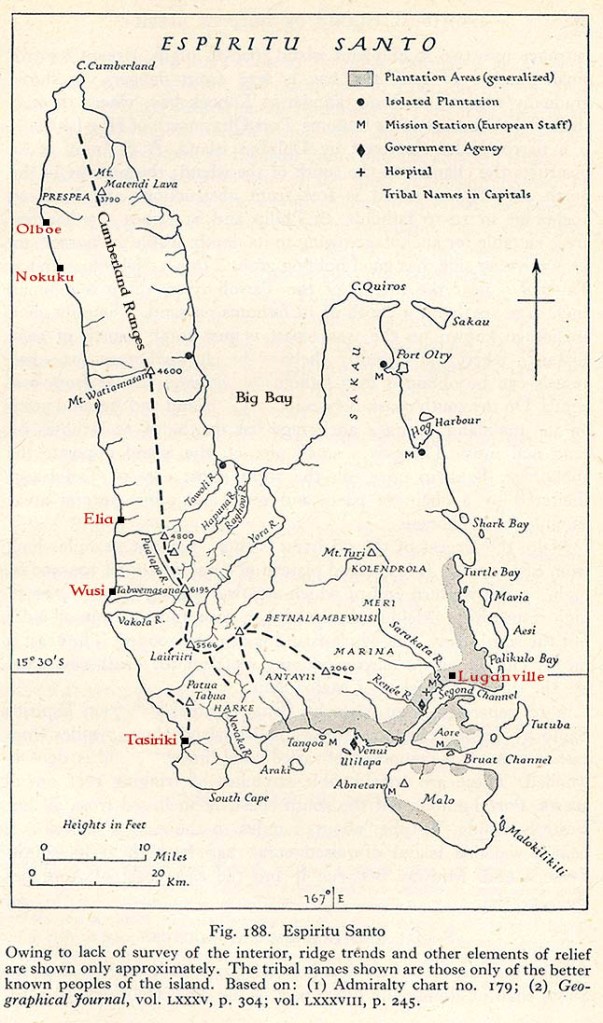
After sailing around most of the islands of the New Hebrides, Francis bought several pieces of land on the islands of Malo and Espiritu Santo (which everyone just called Santo). One of his land purchases became his home, his ‘station’, which he called Sana Roba. Sana seems to be Spanish or Portuguese for ‘it heals’, and Roba, ‘it robs’! Francis was not very well during his time in the islands, which might explain why he named his station something that sounds like a health thief.
At Sana Roba, Francis built all of the buildings himself, including a house, storehouses and little huts called smoke houses. He farmed vegetables and chillies. He had a boat called May and a crew of natives who sailed the islands, bringing back coconuts that even more natives would place in the smoke houses where the coconuts would dry out so that he could make copra. Copra is the dried meat of a coconut which is then used to make coconut oil. Once the oil is removed the rest is used for animal feed. Copra is a dangerous cargo as it can catch on fire easily, setting the ship on fire with it, so not all ships wanted to have it on board.
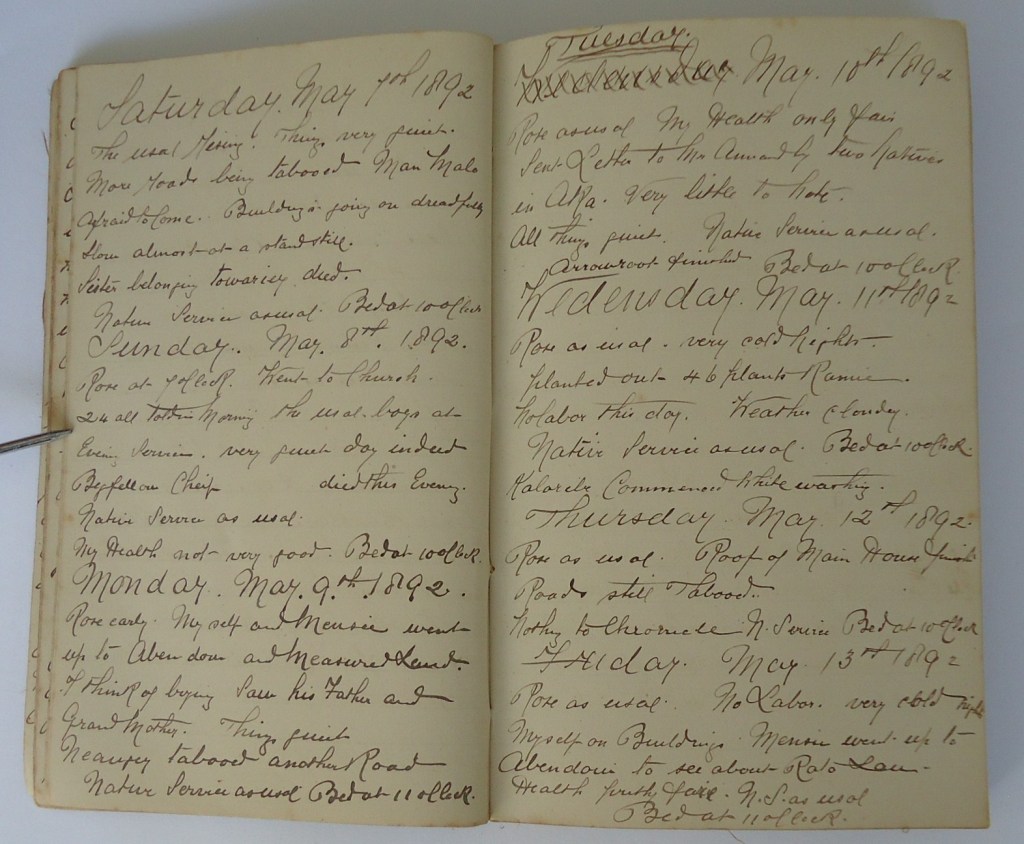
While he was in the New Hebrides, Francis kept a small diary. It was just big enough to hold his words, and just small enough to fit in his pocket. At that particular time in New Hebridean history there was a lot of conflict between the native tribes and from time to time he wrote about it:
Sad news this day. Man Malo murdered another native both of one village. It appears that the native’s dog killed the other native’s pig. He went and demanded a pig for his loss. The other refused. They fought. One speared the other and he killed him with a tomahawke. Over one hundred deaths has occurred this side of Malo lately.
There were a number of French and English navy ships called ‘Men of War’ in the area. They were supposed to be a little like the police, there to take care of the white settlers and Missionaries that lived in the islands. Instead, if they heard that a native had committed a crime against a white person, they sometimes used the native villages as target practice for their cannons or burned entire villages to the ground.
When the man that Francis had travelled to the New Hebrides with was killed by the natives, the English and the French sought justice. Francis was expected to assist one of the Captains of a Man of War to find a village where they believed the murderous natives were hiding. Meanwhile two other parties were doing something similar. He wrote about his experience:
Monday June 6th 1892
After a restless night the bugle sounded at ½ past 4 o’clock. Myself and Capt called at about ¼ to 5 o’clock. Had my bath on deck after some cocoa and bread and fried sardines etc. and then I got armed by having a Navy belt, water bottle and six chamber revolver strapped on and all being ready we landed and arrived on shore and had to wait for day break to start our journey to “Nelsemoonia” via “Belseakey”.
At sunrise the French Man of War landed a party of 50 men all told at a village called “Nouche” close to the island of Tangoa. Her M.S. Katoomba landed a party of 40 men all told at our landing place at Tangoa and the party that I was attached to which landed at Belseakey were 30 all told. All started at daylight. The Frenchmen arrived at a village called Nas-a-boo and commenced operations by burning down all the houses in the village, tore up their plantations, killed their pigs and looted the place throughout but no natives was to be seen anywhere. They secured four sniders. While the Frenchmen were shelling away the Englishmen were shelling away on the other village called Nelse-noon-ai and completely annihilated the place and secured four sniders killing pigs etc. but no natives to be seen anywhere. After completing their destructive work they returned to their ships and arrived about midday after what I termed doing nothing. I felt disgusted to think that after 10 months consideration time was not permitted to allow the following up of the natives they must have been close at hand and they must have been surprised or they would not have left their sniders behind. They must have cleared out to another village over the hill called “Woona-bay-aora” about 1 hour from Nelse-noon-ai. If time had been permitted our party and that meant sleeping in the bush we could have come in at the back of the village and the two other parties coming up the other paths we would have been able to surrender the village and secured the murderers. Not so permitted! And how does the case stand now! Why just this the natives are alive to butcher any other white man they may come across.
Francis was often waiting for the steamer to arrive. The arrival of a steamer was especially good news – it would bring news from home, news of the world, visitors and hopefully buy some of his produce. Often he was waiting for someone in particular and made extra preparations…
Along at missionary’s all day and helped made the butter and got some fruit and made up a beautiful bunch of flowers for the table. Everything all ready and getting sick at waiting so long... No steamer. Delays like this are terrible...The steamer arrived this afternoon. I went out in missionary’s boat to steamer and found that Mr and Mrs Landells and family was left behind at Aneityum on account of the illness of children and Miss Davis did not leave Sydney this trip. Great disappointment to me which put me out awfully. I am sore vexed after having everything all ready then to be disappointed like this... Commenced a long letter to Miss Davies which kept me up til 1 o’clock and then retired.
Miss Davis is Mary Davis, mentioned often as Miss M, Miss D or Miss MD. Francis was always waiting for news from her or the arrival of her and was always left disappointed!
One of the worst things to happen to Francis while he was in the New Hebrides was to live through a devastating hurricane season. There were two really bad ones that hit the islands in the early part of 1893. When the first hurricane hit the northern islands of the New Hebrides in January, a few steam ships and small boats were out on the sea. Francis’ good friend Captain Munro was out on the Steam Ship Croydon. A crewman on the Croydon wrote:
At 4 p.m., there was a lull of a few minutes; then the hurricane commenced again from the north-east with redoubled fury, the wind howling with a roar like that of artillery, and lifting volumes of water, bodily drenching everything. The boats in the davits were rolling right into the sea, and the seas were washing right over the deck. The three passengers who were on board stood for a while in the alleyway by the engine room, where every few minutes they were up to their middles in water. As the night wore on, these were persuaded to go below to wait for the end there…
Over several days, Francis told the story of his terrible night in the storm:
… a hurricane the like of which I never saw before and continued the whole night. Myself and Moley Double (deaf) took shelter under a large rock close to the shore and there spent a most miserable night. The horrible noise of trees falling down and uprooted will never be erased from my memory. We remained on the verandah till the front portion of the house and verandah gave way then we made for the salt water the only outlet to secure our lives. It was a terrible night to me and not being well I thought it would kill me. The Croydon passed here this morning for Aoba. I hope she is safe.
Sunday night seems as if it would never come to an end but at last it came amidst the howling of the wind it being somewhat abated. And on look around I had only one building uninjured. All my other buildings collapsed. A terrible wreck. Nearly the whole of the breadfruit broke down and torn up. Bananas, yams, mambreys, mummery apples, ruseys, in fact everything in the shape of fruit trees blown down and uprooted. A woeful tale given to me today by what few came to see me. There is so much timber blown down and foliage that the roads are entirely obliterated. What they will do for food or I shall do for C.Nts I cannot say.
Rose early. Everything looking desolate and dreary as if we were plague stricken. No one about only the roar of the sea on the rocks. The bird kingdom seemed to have passed away.
This hurricane was followed by what was later called The great island hurricane of 1893.It started in the north on March 5, around where Francis was living. Newspapers reported:
The people in the Sovereign describe the country as having just the appearance one might expect it would have after being swept by a desolating fire. In a land where bananas and cocoanuts form about the only products depended upon by the inhabitants to support life … there was little left of either the one fruit or the other. … driven by hunger to extremities the natives at Malo were subsisting chiefly on fish, with such supplies of unripe and decayed fruit as they could find about the country. Men, women, and children were, as a result of this diet, dying by hundreds from dysentery. The bodies of the victims were literally strewing the country, and the sight one of the most terrible ever witnessed in the islands. … the withdrawal of the steamers has proved a severe blow to the commerce of the islands, and settlement is languishing
The second hurricane didn’t effect Francis much. What almost killed him was a terrible sickness with fevers coupled with the withdrawal of all shipping in the area so that whatever produce Francis had on hand was left to rot. Francis got sicker and sicker until he stopped writing in his diary. By the time Francis started writing again, five months had passed. He described those months as:
… five weary months that would, if I had known what I had to undergo, have turned my hair as white as the driven snow. Could we withdraw our footsteps I think many would; I at least would do so. … Let us then look back and with a kaleidoscope, focus as it were, and see how things have fared with me and I will leave you to judge between ‘beds of roses’ and ‘thorns in my side’. No news from the outside world. My mind has undergone many changes, the present surroundings has not at all been beneficially inclined towards me.
By December 1893, trade must have picked up because suddenly Francis had enough money to pay natives to work and live on Sana Roba station for a full six months while he went on a trip to Sydney, where he arrived in late January 1894.
What was he up to?
 KINdling