Introducing Janet Meldrum, my 3x great grandmother in a direct female line. And what a great grandmother she was, perched up there atop a line of very great women!
Janet Meldrum was a house servant from the town of Dunfermline, Fifeshire, Scotland.
I remember being quite excited to find a Scot in my family line. Before I started researching my family history I’d always imagined myself to come from recently-arrived and very lyrically Irish stock (fiddle-dee-dee to be sure), with a hint of Old Mother England (tally ho!).
It turns out that I’m a Spotted Gum, rather than a Four Leaf Clover, Australian-born for about 150 years, no matter which branch of my family tree I follow. The spots on my Spotted Gum are a gentle sprinkling of English, Irish and Scottish, which I love.
Janet Meldrum came from a long line of Dunfermline weavers.

Some of the Meldrums were well known characters around Dunfermline. The Fife Family History Society gives this description of Janet’s grandfather, Henry Meldrum:
He was a man of uncommon appearance – somewhat above the average height, somewhat bulky in the body, loosely dressed, generally bare-headed, his sandy coloured locks clustering elf-like round his head … His garden then reached down to the ‘haugh’, a stretch of common land … whereon the feuars pastured their cows. Henry was fond of flowers and fruit trees, and the boys that herded cows on the haugh were no less fond of Henry’s apples … And Henry, with his open vest and flowing locks, might sometimes be seen chasing his garden plunderers as far west as the bend at Drymill.
If I close my eyes I can picture sandy-locked Henry, chasing the young apple thieves across the common, shaking his fist in the air, curly locks flowing… And then I think about Janet’s father:
… a strange-looking, wild-eyed, tousy-looking man … his feet were enclosed in worn out ‘bauchles’ and his trousers were generally hung by one line of bracing. James cultivated flowers and was a famous ‘bee’ man of his time.
Based on these two passages, it seems that the Meldrums were wild-eyed, tousy-looking, sandy-locked, fruit-and-flower-loving, bee-keeping weavers. And I am the fruit of their family tree. Love it!!
Janet arrived in Australia in 1849 on board a ship called Thomas Arbuthnot and most likely arrived owning almost nothing. During the mid-1800s, right about the time of Janet’s ocean voyage, power loom weaving was introduced and the town’s traditional hand-weavers quickly found themselves out of work. This probably led to Janet’s decision to go to Australia.
Just three months after her arrival in Sydney, Janet married Robert Evans, a Redcoat soldier. Mary Evans was born in Newcastle in 1850 and Ellen Evans was born in Parramatta in November 1851. I am descended from Ellen, in case you’re wondering.
By January 1852 the Evans family were living near Braidwood, close to the goldfields, where Robert was a mounted policeman.
On Sunday 11 January 1852 Robert rode into town and got drunk. The last anyone saw of him was when he rode off, heading to a local waterhole to give his horse a drink. The horse was found later that day, drowned, floating in the waterhole. Robert’s body was not found until the next day. What unfolded at that waterhole, the blow-by-blow detail, remains a mystery.
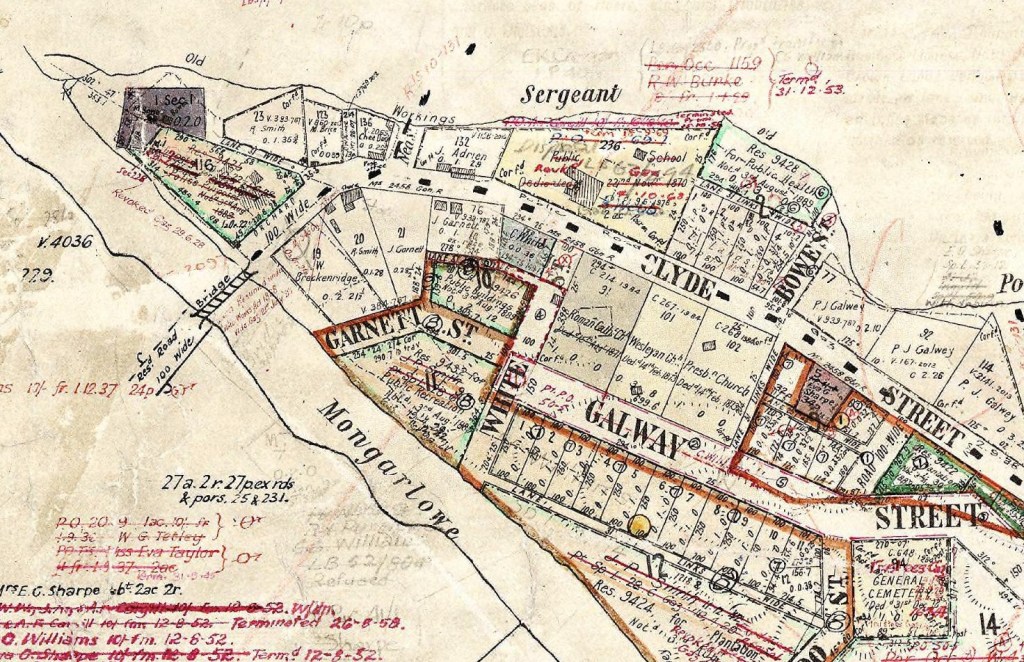
Just four months after Robert’s death, Janet married James Garnett. Janet and James settled in the township of Little River, later known as Mongarlowe, a small village about 16 kilometres east of Braidwood on the Mongarlowe River.
They opened a store called Our Store in Mongarlowe and began a family, adding four children to the two that Janet already had. The store was doing a brisk trade and in October 1860, James made several property purchases in the rapidly developing township of Braidwood.
in April 1861 he was granted a licence for The Free Selection Inn. As well as accumulating property, through the careful running of their store and inn, Janet and James were now making a healthy living providing goods, services and accommodation to the ever increasing gold mining community. The street adjoining their Inn was called ‘Garnett Street’.
Over the next few years, James and Janet purchased several properties and acreage in Braidwood and the surrounding district.
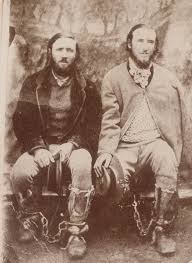
In October 1866, at a place called Meroo, James, his son-in-law Edward Walker and two troopers were ambushed by local bushranger Tommy Clarke and two of his gang, who were waiting in bushes on the side of the road. One of the bushrangers drew a gun and pointed it straight at James. Shots were exchanged the bushrangers bolted, firing as they rode off. A stray bullet hit the peak of a policeman’s cap, blowing the cap from his head, but luckily for him the only damage done was to his cap.
In the heat of the moment, while everyone was distracted by the gunfire, Edward Walker and the other policeman ran away into the bush. Edward later claimed that he fled to save the gold, which he happened to be holding when the ambush happened. According to some newspaper reports, which would be argued over fiercely between the policemen in years to come, the policeman fled ‘… to save what he probably considered fully as valuable as gold – his bacon’.
Bushrangers Thomas Clarke and his brother John, both aged in their 20s, were hanged from twin gallows at Darlinghurst Jail in Sydney on 25 June 1867. James Garnett died just a month earlier, aged only 47, possibly as an indirect result of his experience with the Clarke brothers.
Just before he died, James was in the process of purchasing two large properties in the Braidwood district. Janet completed the purchase, paying the balance out of funds from James’ estate. As James’ legal and personal representative, Janet then became the owner of these two properties along with all of the previous purchases. Janet continued to purchase properties after James’ death, amassing a portfolio of about 19 individual houses and acreages in and around Braidwood.
Fourteen years after the death of James Garnett, Janet Meldrum Evans Garnett married for the third time. On 17 November 1881, Janet married James Park, at The Manse, the Scottish Presbyterian Minister’s house, at Mongarlowe.
On 9 April 1884, Janet Meldrum Evans Garnett Park died from ‘dropsy’, aged about 60. Just days before her death, Janet sold most of her properties, including the two large acreages, for £2070.
When all was said and done, this ancestor of mine, this offspring of wild-eyed, tousy-looking, sandy-locked, fruit-and-flower-loving, bee-keeping weavers was someone to behold. When life all was tallied up, Janet Meldrum had succeeded in finding a life that was exceedingly better than anything she could possibly have created for herself in the Dunfermline world she had left behind. She had defied the odds and the norms. And through her talent for turning nothing into an abundance of something, she had left quite a legacy for her surviving children.
What a woman!
 KINdling