In my hunt for my mysterious MG, my Mystery Great grandfather, I haven’t yet spent a single minute researching this Collman-Weston couple. Perhaps that’s because I have convinced myself that Thomas Collman and Augusta Weston are the right Collman-Weston couple.
But what if I’m wrong?
What if Charles Collman and Louisa Weston are actually my 2x great grandparents ?
Warning – this story is slightly confusing – there is more than one ‘Charles Collman’ in the family line.
Charles Collman’s story begins (unsurprisingly) with events that happened in his early childhood. They concern his father, also Charles Collman (1818 – 1858), so to ease confusion I’ll call them Charles Collman the younger and the elder .
Charles the elder was your classic Australian “squatter”, otherwise known as a grazier – you know the type… a manly man atop a thoroughbred wearing moleskin pants, riding boots, an Akubra hat… always surrounded by dogs and a lot of cattle and/or sheep and romantic clouds of bull-dust. You’re now humming “Click go the Shears” or “Waltzing Matilda”… am I right?

Back to the Collman story… Charles the elder had two large sheep and cattle stations called “Boloco” and “Boloco Creek”, somewhere near Cooma in southern New South Wales. Its in a region called “Monaro” (please say Mon-AIR-o… and NOT Man-R-O… that’s a car!).
The Monaro Pioneers website says this about Charles the elder and his parents…
Charles Collman was born in London in 1818 to Edward Lawrence Collman and his [wife] Ann Collins. His father was transported to NSW as a convict per Canada in 1819, while Charles, his mother and a half-sister arrived three years later on board the Providence. Acrimony between his parents meant that Charles spent some of his childhood in the Orphan School before settling with his father at Inverary Park.
By the late 1840’s Charles was residing at the squatting run “Boloco”, south-east of Jindabyne, held under licence by James Keirle. Charles acquired the licence for the neighbouring “Boloco Creek” run from John McGuigan in 1854, and “Boloco” itself from James Keirle in 1855, the latter apparently in return for an annuity. Charles was a successful grazier and died in 1858 leaving a large estate.
Susannah Williams was the youngest daughter of John Williams and Sarah Nash and was born in 1833 almost certainly at her parents’ squatterage south of Queanbeyan NSW. A few years later she relocated with her family to the Monaro district, settling initially near Nimmitabel and later at “Groses Plain” south-west of Jindabyne where she was residing at the time of her marriage to Charles Collman (1818-1858) in 1849.
In 1859 Susannah married Irish-born Catholic William Brown and continued to reside at “Boloco”. William died in 1863 and Susannah in 1866, leaving seven orphaned children with the eldest not yet sixteen years of age.
Charles the elder’s father – Edward Lawrence Collman, most obedient humble servant – was not your typical impoverished farm-dwelling or city-dwelling convict. He was an educated man who wasn’t afraid to write to the Colonial Secretary. The ‘acrimony’ between Edward and his wife (thus described above)… lets call it the dirty family laundry… is hanging out to dry in the warm winds of the Colonial Secretary’s papers. It could be a fantabulous story for a future post, methinks.

For now, my focus is on Charles. According to the Monaro Pioneers website and the newspapers of the day, Charles the elder was a grazier of sheep and cattle near Cooma. In 1849 Charles the elder married Susannah Williams and they had several children, including Charles the younger who later married Louisa Weston.
Charles the elder died in 1858 when the children were very young. I might let the newspapers of the day tell the rest of the story…
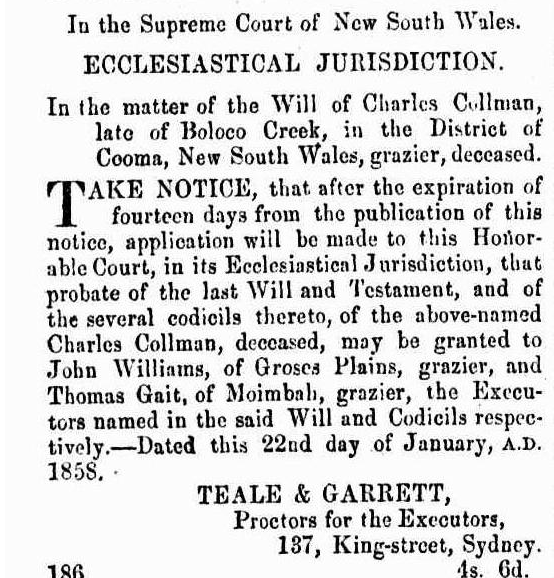
After Charles died, Susannah and the children continued to live at Boloco. When she died in 1866 the children were too young to inherit the two Stations and their interests were placed in the hands of trustees. Enter Druitt and Son…


This 1879 advertisement for the sale of the estate gives a little indication of the size of Charles Collman the elder’s Boloco and Boloco Creek Stations.
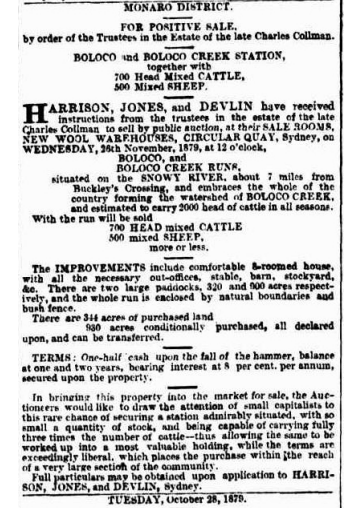
Charles the younger (1850 – 1923) was the oldest son of Charles the elder – he was probably the one leading the court case against the trustees of his father’s estate. The loss of his parents when he was so young and the interesting management of his father’s affairs must have left him growing up in a very different social, emotional and financial position than he might otherwise have been.
And what of the rest of Charles the younger’s life? I know that he married Louisa Weston in Cooma in 1874 and that they had something like nine children – mostly daughters. I don’t know what became of the properties, just that life went on in the Monaro region.
I found this notice about Charles, suggesting that in his adult life, he was engaged in his local community.

But that is about all that I know about him.
No matter where I looked, I seemed to find more information about Louisa than I found about Charles. I can only guess how his early life might have shaped him, what his personality might have been like.
Louisa clearly had a kind heart and was deeply tied to her own family. It seems she took in orphaned or motherless children from within her own Weston family.
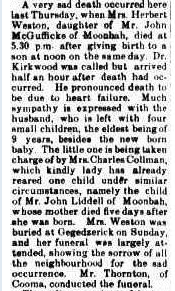
When Louisa passed away in 1921 there was a lovely obituary in the newspaper.
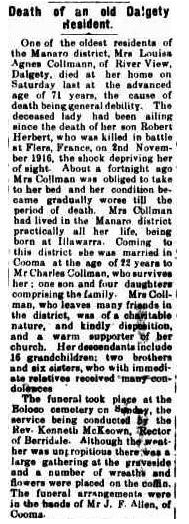
When Charles passed away in 1923, sadly not much was said in terms of an obituary. He and Louisa are both buried in the Boloco Cemetery.


Charles and Louisa had three sons – first another Charles (groan)… but luckily for me there will be a lot less confusion trying to research him because his full name is George Charles Collman. Secondly yet another Charles Collman… but sadly he died as a baby. And thirdly there was Robert Collman, killed in the first world war.
Could George Collman or Robert Collman be my mysterious MG? Can I place either of them in the vicinity of Edna’s mother, somewhere towards the end of 1908?
Time or DNA will tell.
 KINdling