Maria Wood said she was born in Parramatta or Paddington around 1830 – but was she? I’m on the trail of solving another mystery that I didn’t even know I had… until I took a DNA test!
If you’ve been following my KINdling posts, you’ll know that my father grew up in an orphanage.
That left a gaping hole in our family lore. There are no fabulous sepia portraits of previous generations and there are no family stories to pass down to the next generations.
All I can do is combine traditional genealogical research and contemporary DNA research to figure out who I come from.
Unlike the mysteries and roadblocks on dad’s maternal line, the paper trail on dad’s paternal line seems to be reliable. I’ve built a reasonably solid family tree back to my 2x great grandparents. One set of those 2x great grandparents is Robert Dean and Eliza or “Lizzie” Mathews.
On the Mathews line, at least on paper, my 3x great grandparents were Maria Wood and Frederick Mathews.
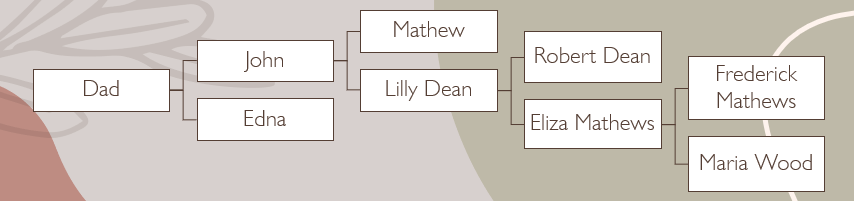
But something doesn’t look quite right as far as my DNA is concerned.
I have 47 DNA matches on my Dean line, but I have only five DNA matches on my Mathews line; the line connected to Frederick and Maria. Which leaves me wondering – are Frederick and Maria really my ancestors?
It’s time to take a deeper dive into my Mathews/Wood family history, starting with Maria Wood.
Maria’s Paper Trail
Maria was supposedly born in Sydney in the early 1830s.
When the births and baptisms of her ten children were recorded in New South Wales, Maria consistently said that her maiden name was ‘Wood’, and that she was born about 1832 or 1833 in Parramatta, or Paddington or just plain Sydney. Her middle name was recorded as ‘Ann’ or ‘Anna’.
Despite numerous searches through the New South Wales indexes, Maria’s birth record remained elusive.
Leap forward to 14 April 1851, when the spinster Maria ‘Fanny’ Wood married the bachelor Frederick William Mathews. The event is recorded in the New South Wales Presbyterian Marriages Register, Volume 80. Maria and Frederick each declared that they were a member of or held Communion with the Presbyterian Church of Scotland.
Couples getting married In NSW prior to 1856 were not required to record where they were born or who their parents were, so Frederick and Maria’s marriage record gives me no clues about that. It’s a fruitless dead end.
The next thing I did was to take a closer look at the marriage records of Maria and Frederick’s children. When I did that, I discovered something very interesting. Maria’s children seemed to think that their mother’s maiden name was McNeish and not Wood at all!


That strange new piece of the puzzle made me go back over records that I had already seen, looking for traces of the name McNeish.
And I found it in two places.
First in the marriage record, where a person named Eliza Macnish (not McNeish but very close) had been a witness to Maria’s marriage.
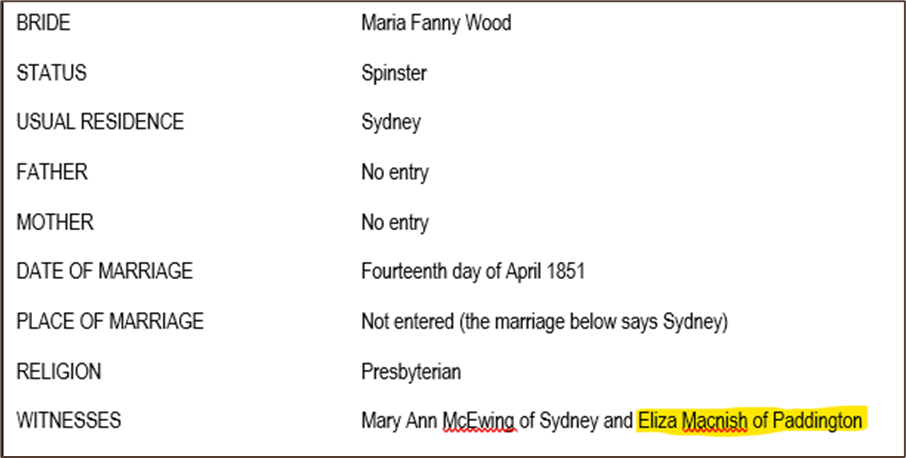
Next, in the newspaper. When Frederick died in 1870, Maria used a lawyer named Macnish.

On a hunch, I then searched on ancestry.com for Maria Macnish instead of Maria Wood and I almost fell off my chair when I found this cluster of family trees:
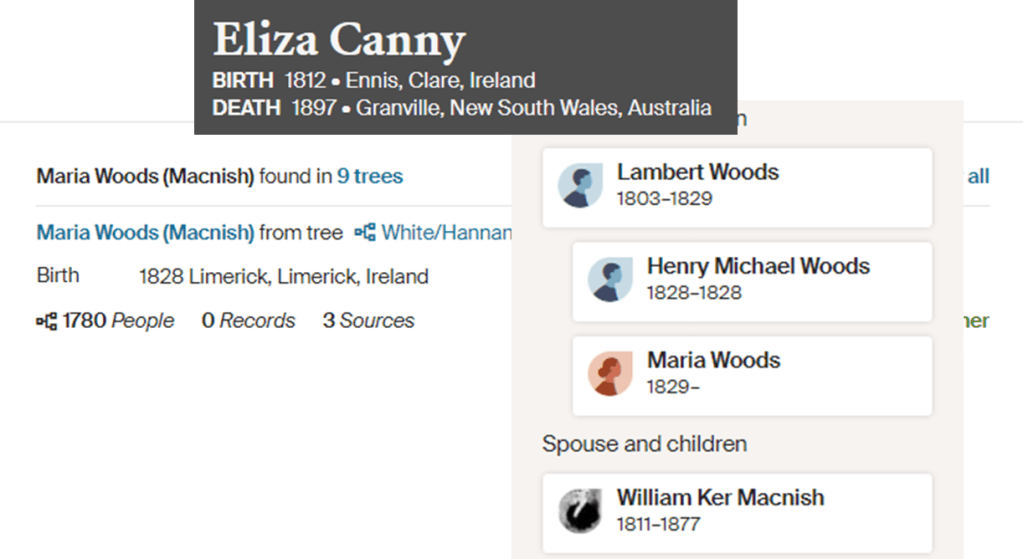
The owners of these trees knew that their Maria Woods was born in Ireland in 1829, but they knew nothing more about her. I knew that my Maria Wood got married in Sydney in 1851 but I didn’t know anything about her before that date.
Questions – was my Maria Wood and their Maria Woods the same person? Could I prove it?
With my genealogist hat planted firmly on my head, I was off to do a deep dive into the life of Eliza Canny.
The Irishwoman Eliza Canny
Eliza Canny married Lambert Woods in Ennis, Ireland, in 1827 when she was about 15 years old. She gave birth to a son, Henry Woods in 1828 and he died the same year. She gave birth to a daughter, Maria Woods in 1829. That same year, her husband Lambert died, leaving Eliza (now Mrs Woods) a bereaved widow and the single parent of a baby girl, and all of that by the age of 17.
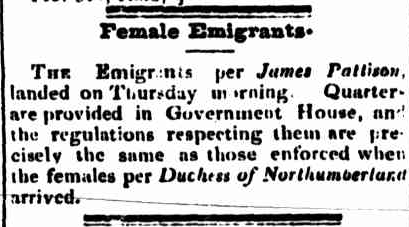
In 1835, a housekeeper and needlewoman named ‘Elizabeth’ Woods, aged 24, and her daughter Maria Woods, aged 7, boarded the ship James Pattison which arrived in Sydney in February 1836. Eliza was to be ‘engaged by’ her brother, Henry Canny. Passengers were unloaded from the James Pattison at the King’s Wharf and from there they went to Government House, where Elizabeth and Maria waited for a week before they were collected by Henry.



Henry Canny was a convict who then became a Government employee. In 1836 he was employed at Parramatta Hospital. In later years he would become the Clerk of the Legislative Council. Henry’s is a fabulous story, one for another day. The important part of this story, as far as Henry Canny is concerned, is that he lived in Parramatta.
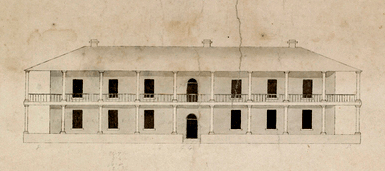
Dictionary of Sydney website,
https://dictionaryofsydney.org/entry/the_colonial_hospital
On 16 December 1836, the widow Eliza (nee Canny) Woods got married twice on the same day in two different churches! At each ceremony, the bride and groom were the same, the witnesses were the same, only the church and the minister changed. One ceremony was performed at St Mary’s Roman Catholic Church and the other was performed at St Andrew’s Scot’s Church. The bridal couple each certified their religion at their own church. Eliza Canny was no longer Mrs Woods but was now Mrs William Ker Macnish… and he lived in Paddington.
Analysing the paper evidence
What does it all mean for my mission to prove that Maria Woods born Ireland is the same person as Maria Wood who married Frederick Mathews?
There are a lot of pieces of information to say that, on the balance of probabilities, they were the same person.
- I have placed the young child Maria Woods in both Parramatta and Paddington, the places where my Maria Wood claimed to have been born.
- If the two Marias are the same person, Maria’s mother Eliza Macnish was a witness to her marriage to Frederick and her stepfather William Macnish took care of legal matters when Frederick died.
- When I compare the names of her children using the naming conventions of Ireland, there are a lot of matches. If the two Marias are the same person, she named two of her sons after her father Lambert, one of her sons after her brother Henry, one of her sons after her stepfather William and one of her daughters after her mother Eliza.

But the icing on the cake as far as the paper trail is concerned lies in the records of Eliza (nee Canny, Woods) Macnish. During the later stages of her life, Eliza was an inmate at the Newington Infirmary.

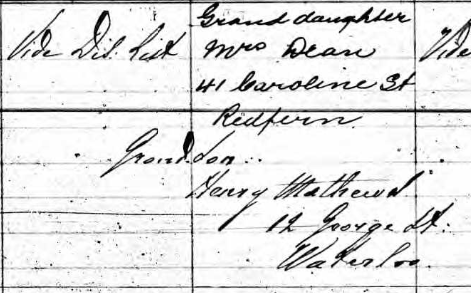
The names and addresses of the people that were included as Eliza’s relatives – her grandson and granddaughter, Henry Mathews and Mrs Dean – were exactly the same as the names and addresses of people in my family tree. “Mrs Dean” is both Eliza’s grandchild and my 2x great grandmother.
On paper, it might now seem proved but to get from “balance of probabilities” to “beyond reasonable doubt”, a conclusion ideally needs to be supported with DNA evidence.
Analysing the DNA evidence
I have five matches that all share Mathews DNA.
The first is Belinda, my first cousin. Belinda’s DNA test is connected to my tree; we share one tree. Belinda and I descend through Eliza Mathews’ daughter Lilly Dean. I have access to the results of Belinda’s DNA test.
The second is Margaret, our 2nd cousin 1x removed. Margaret descends through Eliza Mathews’ son William Dean. I have access to the results of Margaret’s DNA test.
Having access to both of their test results lets me look at the results from different perspectives. I’m always fascinated by the randomness of DNA. Even though Belinda and I are related in exactly the same way to Margaret, I only share 22cMs across 1 segment of DNA with Margaret but Belinda shares 166cMs across 10 cMs with Margaret!


The other three matches are Margaret’s first cousin, and that person’s two children. They are not known to me and can’t be contacted.
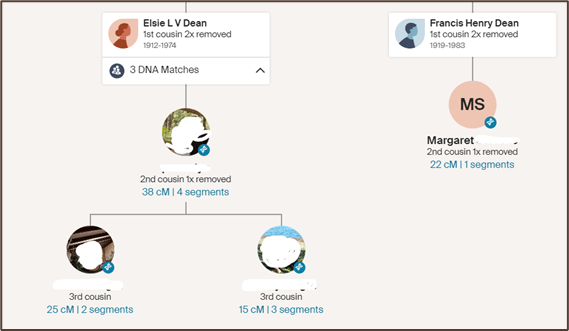
With the analysis of the paper trail completed, Margaret and I then added Eliza Canny and Lambert Woods to our family trees.
There is a tool in ancestry.com called ThruLines. It’s a clever tool that shows you how you might be related to your DNA matches through ancestors that you share. As a friend of mine says, the hints that ThruLines shows are ‘guidelines’ not ‘tramlines’; they are suggestions, not proof, and like everything in genealogy, verification through careful analysis is an absolute must.
We all waited patiently to see whether the addition of Eliza and Lambert to our trees caused anything to change in our ThruLines. After two weeks of waiting, nothing changed in mine or Belinda’s ThruLines.
But after only 24 hours, Margaret got a single new ThruLine – a match with a descendant of James Henry Macnish; one of Maria’s half-siblings. And that’s when the lightbulb moment happened. Maria was effectively an only child; she had no full siblings, which means no other lines for the DNA to pass down. How might that possibly impact our DNA inheritance? Surely it reduces our chances?
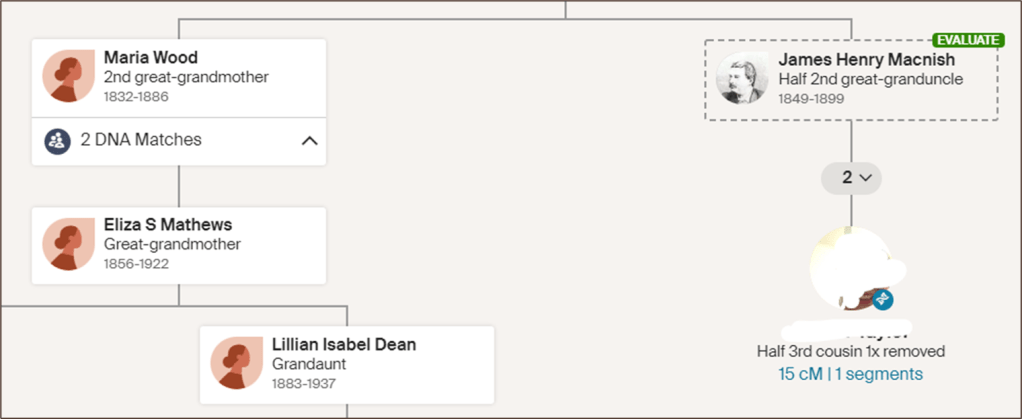
Margaret’s new match with this person is only small. And because Margaret is a whole generation closer to Maria than Belinda and me, the likelihood of any DNA coming to us from Eliza Canny is looking quite remote.
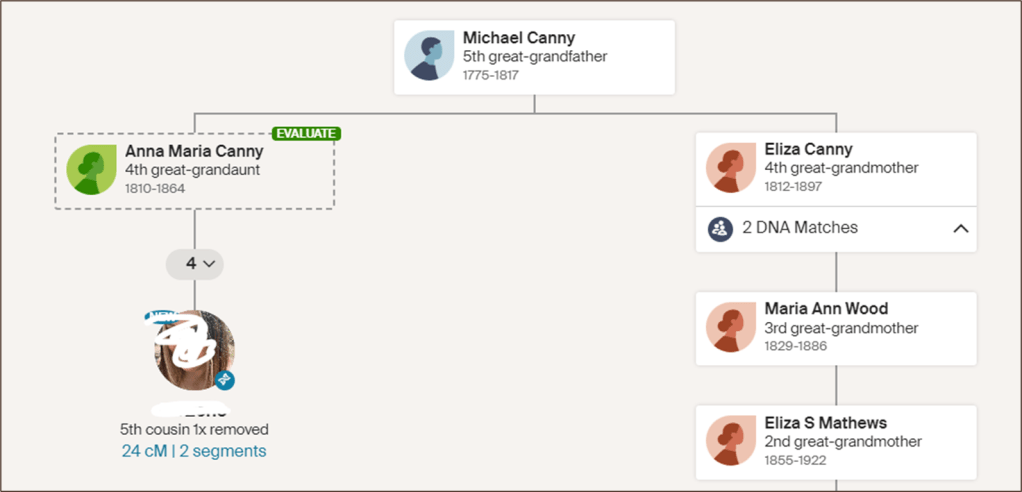
At least that’s what I thought until I woke up one morning to a new Thruline; a match with a descendant of Anna Maria Canny, a sibling of Eliza Canny. Margaret also has this match, but my cousin Belinda does not.
Conclusions
So where does that leave me? On paper, Maria Wood and Eliza Canny are my ancestors. But when it comes to DNA evidence, it simply isn’t enough. I need loads more DNA evidence before it could even come close to ‘proved beyond reasonable doubt’. I might even need to try chromosome analysis because these ancestors are too distant.
Right now, I’m looking for other Mathews descendants who have taken a DNA test or are willing to take a DNA test. If I make any progress, or if I get any significant new matches, I’ll let you know.
In the meantime, I’ll start my deep dive into Frederick Mathews. But I have to admit, at this stage, I don’t feel confident that I’m genetically connected in any way to Frederick. Time will tell.
 KINdling