When James Neale, a Private in the 4th (King’s Own) Regiment of Foot boarded the copper-fastened teak convict ship Jane in Deptford, he was bound for New South Wales. Family lore says he was making a quick escape from the stormy seas of his second marriage. Little could he know that even more troubled waters lay ahead…
The voyage itself was not so bad. The Royal Navy surgeon kept a detailed account and other than a bit of scurvy amongst the prisoners, things on board the Jane were all ship-shape, ahoy.
On the 21st of April one hundred and thirty male prisoners embarked on the Jane from the convict hulk Surprise, Cove of Cork and on 12th September five embarked at the Cape of Good Hope, all in apparent good health. Although the ship was six months and some days in the passage to N.S. Wales, 11 weeks of which she was detained in the tropics, we remained generally speaking healthy on board, being all the time free from contagious disorders.
The usual means were resorted to for keeping the prison sweet and clean, and in damp weather as dry as possible, which was on some occasions rather difficult being no charcoal on board for the airing stoves owing to some mistake at Deptford.
The prisoners were also kept clean and orderly, both in their berths and in their persons and were all admitted on deck in fine weather during the greater part of the day so that when they were sent below in the evening there was a complete removal of air in the prison. Thin beds were stowed away on deck every day and were invariably once a week opened out and shook in the open air. I found the chlorate of lime very useful in the prison, particularly around the [soil brush?] etc.
Scurvy, however, became very prevalent among the prisoners but not until we were nearly three months at sea. I am rather at a loss how to account for this disease particularly as it was altogether confined to the convicts and many of these men who were of an active [twine?] and made themselves altogether useful on deck did not show the least symptom of it therefore I am inclined to think that want of exercise was a principal cause which could not be remedied on account of the smallness of the vessel. In the Larkins I had only one case of scurvy during the passage and the prisoners if anything appeared more healthy on embarkation in the Jane than they did in that ship, and both having embarked their prisoners at Cork too, I cannot account for it in any other way than this, particularly as the provisions appeared equally good in both ships unless as I found the lemon juice not so good nor so fresh as I did on the Larkins. I found the “solution of nitric” a most efficacious remedy and perfectly agree in opinion with W.D. Patterson Surgeon Royal Navy that by it, “scurvy may be cured at sea without the assistance of recent vegetable matter”. W Charles Cameron Surgeon R.N. deserves great credit also for the manner in which he describes the solution to have action on his patients in the [Ferryman?] convict ship.
As the usual supply of nitric solution in convict ships is very insufficient particularly where scurvy prevails I could not afford to dissolve as much of it in the lime juice as those gentlemen did however a few days after I commended the exhibition of it I ascertained that there was a considerable quantity of it on board for ship’s use, which the Master was kind enough to let me have, and which enabled me to dissolve two ounces in each quart instead of one, making the solution double the strength it was at first.
Oliver Sproule, Surgeon.
Ancestry.com. UK, Royal Navy Medical Journals, 1817-1856, Jane 1831
How did James really come to be on the Jane? Was he really running away from a failed second marriage?
On the 13th of July 1820, in the Parish of Holt, Bradford, in the English county of Wiltshire, James Neale married Mary Keen after having posted Banns on three previous Sundays.

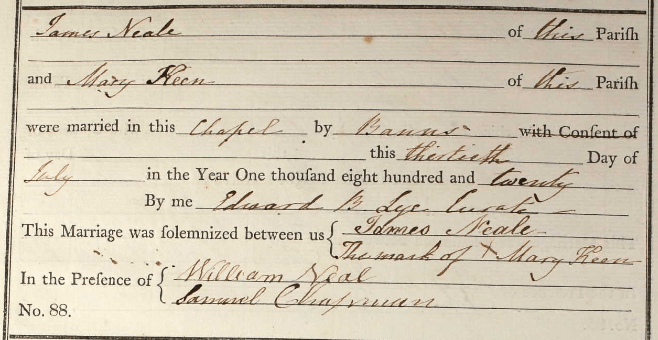
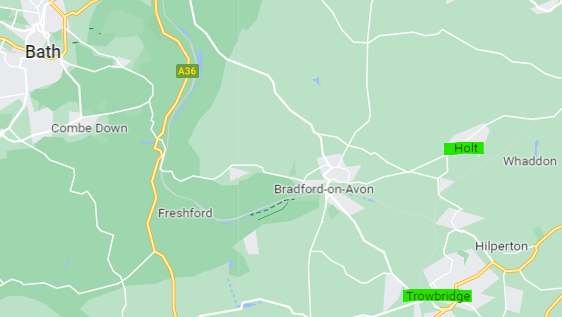
A somewhat suspicious six months and one week later, their daughter Caroline was born. She was baptised at the Tabernacle Church in the nearby market town of Trowbridge when she was two and a half months old.

James’ occupation on the day of Caroline’s baptism was ‘spinner’. From about the 14th century, Trowbridge had developed as a centre for the production of woollen cloth. In 1820, the Trowbridge industry was thriving, with more than 20 woollen cloth factories employing many of the town’s inhabitants. As a spinner, James was very likely employed in one of those factories.
Leap forward more than 100 years, when Caroline’s son Francis wrote about his mother’s parents in a letter to his son. Was he filling in some historic blanks or throwing a woolly blanket over the truth?
…Her mother died when my mother was born. After a little while he married again, and I believe they could not agree so he enlisted as a soldier and was very soon drafted to New Holland…
Letter to his son Ernie, 2 July 1925, Francis Charles Sendall
So far, no tangible evidence of the death of Mary Neale (nee Keen) has been located… but…
On 1 April 1823 a widower named James Neale married a spinster named Mary Pearce at St James’ Church in Trowbridge after having posted Banns throughout March. Just like the 1820 marriage, one of the witnesses was William Neale. While it isn’t certain that this is the marriage of the same James Neale, it’s a neat fit into the story told by his grandson in 1925.
The muster rolls and pay books of the 4th (King’s Own) Regiment of Foot reveal that James Neale, a spinner whose birthplace was Trowbridge, enlisted into the Army on 7 April 1824. At that moment, according to the Biographical Dictionary of Australia, the Regiment was in the West Indies where they had been since 1819 and would remain until 1826. They were then in Portugal, England, Scotland and Ireland from 1826 until 1831. Perhaps James was in some of those places with them… we may never know.
The muster rolls and pay books of the 4th (King’s Own) Regiment of Foot were digitised by the Australian Joint Copying Project and are available at their online portal. https://www.nla.gov.au/using-library/research-tools-and-resources/australian-joint-copying-project
The available rolls of the Regiment commence in 1831, just in time for James Neale to embark at Deptford on 25 March 1831 and then depart from Cork on board the convict ship Jane on 29 April 1831.
In May 1831, the Sydney Gazette reported that “…the Fourth Regiment of Foot (the King’s Own) is expected to be the next that will embark in the prison-ships, to perform their sojourn of four or five years in these Colonies, previous to going on to India… The 4th Regiment has latterly been doing duty in Scotland...” Detachments of the 4th began arriving in Sydney on various convict ships from November of that year.
On 8 November, the Sydney Gazette reported the arrival of the Jane.

One month later the Sydney Gazette claimed that “…The whole of the 4th regiment, with the exception of the depot in England, is now either at sea as guards on board prison ships or have already arrived in this or the sister colony...”
By January 1832, newspapers were reporting that the Headquarters of the 4th were now at Launceston in Van Diemen’s Land and the Sydney Herald of 26 December 1831 had probably reported the next – and last – leg of James’ voyage.

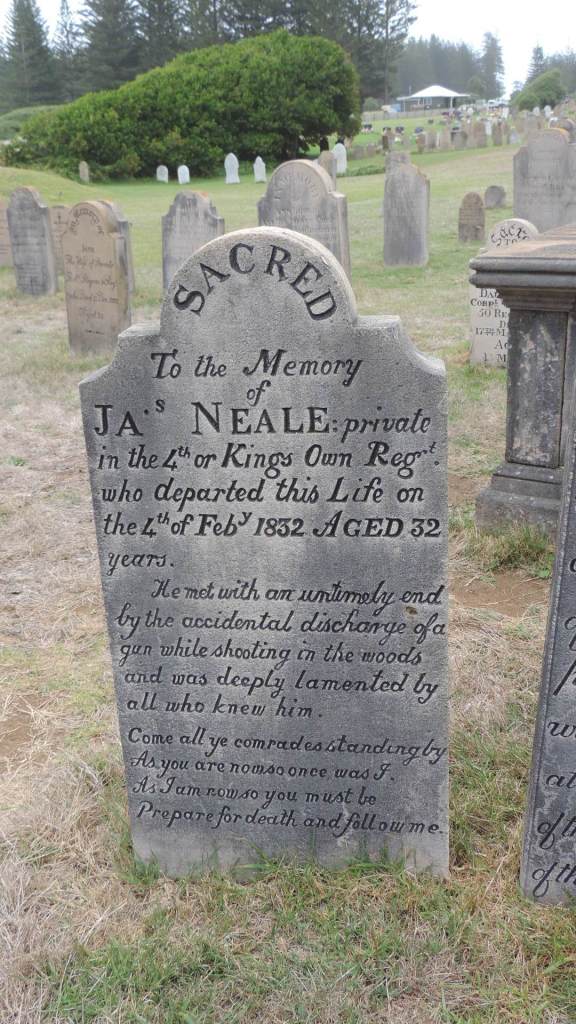
A headstone in the Norfolk Island cemetery records the last moments of James Neale’s life and his muster roll records that his next of kin was his wife, Mary, who was living in Trowbridge. Was this his first wife, Mary Keen, or was there indeed a second marriage to Mary Pearce? It’s something else that we may never know.
James rests in the nicest place, gazing out at the blue Pacific Ocean. While he rests, I’ll be focused on using DNA to try to solve the mysteries and I’ll keep searching for records that document the untimely end of my 3x great grandfather, James Neale.
 KINdling