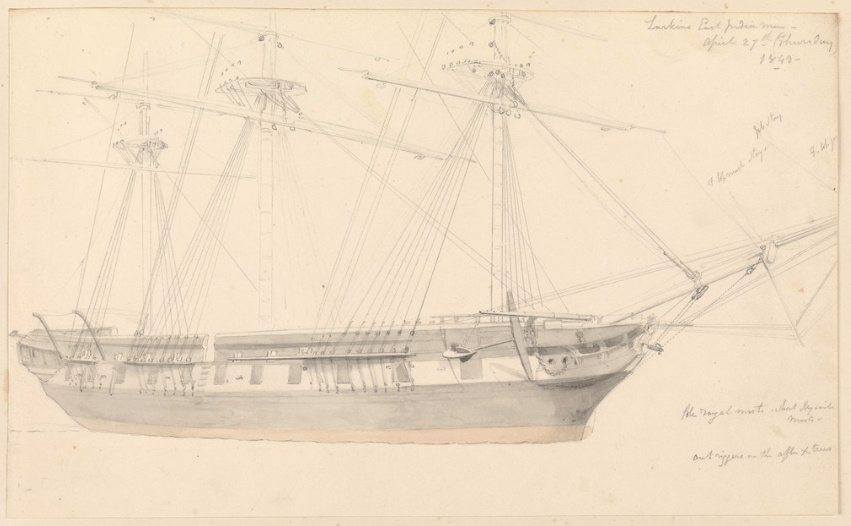
It was late May 1831, and the ship Larkins was at Deptford preparing for departure. She was to deliver a cargo to Van Diemen’s Land and then bring back tea from China.
On board, William Evans (the Royal Navy’s Surgeon), began to write in his journal while Captain William Campbell, Lieutenant Espinasse, Ensign Fortescue, Assistant Surgeon Parry, the rank and file plus several women and children belonging to the 4th Regiment of Foot were noisily stowing their goods and chattels.
On the first day of June the Larkins was towed down to Woolwich by the steam vessels The Queen of the Netherlands and Columbine, where she was lashed alongside the Monmouthshire Hulk.
Surgeon Evans inspected the convicts on the Justicia Hulk in preparation for their embarkation. On the third day of June, Larkins cast off and was towed down to Gravesend by the Columbine. The following day they worked their way down the river and anchored off Sheerness dockyard.
On the sixth day of June, Surgeon Evans inspected 50 convicts on board the Retribution Hulk and 30 more on the Euryalus; he rejected one man due to ill health. The next day, 100 convicts, including my 4x great grandfather James Goodson, came on board from the Cumberland Hulk.
When a boy from the Euryalus Hulk came on board to replace the man rejected the previous day, the number of convicts on board Larkins was 280; 60 too many according to Surgeon Evans.
Before Larkins left the port, Surgeon Evans drew up a set of Rules and Regulations that were distributed amongst the convicts “in order to secure anything like a state of subordination among them”. But despite his long list of rules, the behaviour on board Larkins was not destined to be to Surgeon Evans’ liking.
- The convicts must behave themselves in a civil and becoming manner to all the Officers and any other persons placed in authority over them.
- The convicts must also behave themselves in a descent, becoming and respectful manner at all times when prayers are read to them, or divine service performed.
- No convict is to cut, alter or destroy any of the clothing, bedding or other article given to him, or to appropriate them to any other purpose than what they were intended for when given to them.
- Any convict stealing or secreting any of the ship’s stores, or any article belonging to the ship or any other fellow prisoner will be severely punished.
- That no quarrelling or fighting or any abusive language be used by any convict in the class or anywhere else on board.
- That the overseers do maintain good order in the classes, day and not permit any convict to smoke below, or shifting about on the decks and must report any disorderly conduct.
- Two inspectors be appointed every day, one out of each mess, to be taken by rotation to supervise the issue of provisions and the cooking thereof and distribution among the convicts and they must make a daily report thereof to the Surgeon.
- The water closets must be emptied and made clean every morning before breakfast by the messes, to be taken in rotation.
- The decks in the prison must be swept, scraped, rubbed and made clean immediately after any meal and the convicts must be up and dressed and their beds properly made up by 6 o’clock every morning. Meal time breakfast at 8 o’clock and dinner at 1 every day.
- The convicts must wash themselves and comb their hair every morning before breakfast and must keep their dress and persons as clean as circumstances will admit. They must not throw out through the portholes the scuttles or into the hatches any bone or filth and should it rain at any time when they are mustered on deck each convict must immediately go below without being told to do so and must at all times take special care that their clothes in bed do not get unnecessarily wet by a shower of rain or otherwise as they will be severely punished for any negligence in this respect. And the Overseers are particularly requested to make this known to each convict individually and also to see that this Rule as far as regards their duty is strictly adhered to by the convicts.
- All convicts must retire to their respective beds at 9 o’clock and no noise is to be permitted after that time.
- Every convict must wash his own clothes. Washing days appointed for the purpose are Tuesday and Friday in each week; and each convict must have a clean shirt to be put on every Thursday and Sunday morning.
- All complaints must be reported to the Surgeon in the forenoon of each day. No complaint will be listened to unless it is reported on the day it happened.
- Any convict offending against any of the above Rules and Regulations will be punished.
Surgeon Evans selected the most suitable prisoners to “carry the said Rules and Regulations into effect”.
With the rules in place, Surgeon Evans then appointed a schoolmaster to Superintend the boys on board, and to muster them every morning at 9 for inspection. He also selected a cook and appointed Superintendents of the washing.
On 15 June, Charles Love attempted to escape the ship by taking off his irons and concealing himself under a tub on the deck. When he was found to be missing from muster, all the convicts were sent below, and the ship was searched. Charles Love was quickly discovered and doubly ironed until the ship was well out of the Channel.
At 12 p.m. on 16 June the Larkins finally got under way and by 25 June they had worked their way down the Channel. In the evening it
“blew a fresh gale from the southwest, with a high tumbling sea”.
The following day a stronger gale blew, and a high cross sea was running. The convicts were suffering greatly with seasickness and the weather and seas just didn’t let up. Torrents of water washed over the decks and into the prison, drenching everything inside and out. There was no way to keep the clothing and bedding dry, other than through the use of the stoves which were kept constantly burning day and night.
When the seas and the weather were calmer, a new rule was imposed; that Divine Service was to be held on the Quarter Deck every Sunday in fine weather, but in boisterous or rainy weather it was to be performed in the prison. The most suitable convicts were appointed to read, or to cause the convicts to read a portion of the Holy Scriptures and other religious books that were sent on board for that purpose.
All of the convicts were to muster every Sunday and Thursday at 10 a.m. to be inspected individually to ensure they were clean and healthy. Otherwise, they were all to be on deck at sunrise and mustered below at sunset.
By the middle of July when the ship neared the equator the weather was sultry and oppressive. When the convicts were mustered below at night, the heat was insufferable. So much so that the vapour exhaled from their breathing condensed on the under part of the deck and beams and it fell down on the occupants of Larkins in heavy drops, as if it were raining inside.
Several petty thefts occurred on board and the perpetrators were punished in front of the others as a deterrent. Despite the punishments, Samuel Bennet was found to have concealed the property of several other prisoners. Samuel Bennet was punished and all of the prisoners were admonished to no effect. Petty crime was as constant as the dampness.
One evening, while the convicts were mustered below, John Higgins attempted to conceal himself in the chain cable socket. His fellow prisoners reported him missing, the ship was searched, and two discoveries were made; John Higgins hadn’t concealed himself very well and John Higgins had broken into the hold where the ammunition, spirits and matches were kept. Lives were thought to have been in imminent danger, but Surgeon Evans wrote nothing as to any subsequent punishment.
They crossed the Equator on 31 July, and the Meridian of the Cape of Good Hope on 6 September, where they experienced a series of heavy gales and rain. Despite every effort, water came inside again and again. The prison and hospital were frequently drenched with salt water, as was the bedding and clothing, and other than the cooking fires there was little means of keeping anything dry. To make matters worse, by 5 October there were 40 cases of scurvy on board, but daily use of citric acid ensured the cases were mild.
On 19 October 1831, after 18 weeks without seeing land, the Larkins dropped anchor in Sullivan’s Cove in the Port of Hobart.
Despite frequent high seas and constant damp, seasickness and scurvy, petty theft and escape attempts, Captain Campbell and Surgeon Evans delivered 280 convicts, 53 Guard, 6 women, 4 children, 52 crew and one Royal Navy Surgeon.
Unlike many voyages of their time, they hadn’t lost a single life.
NOVEMBER 12.-Sailed, the ship Larkins, Captain Campbell, 700 tons, for Sydney, in ballast passengers, Dr. Evans, R. N.; Captain Romney 17th regiment; Captain Williams, 4th ditto; Paymaster Carew, 17th ditto; and Christian Stewart alias Rankin (and her son), per Lady of the Lake.
Thursday 1 December 1831, The Sydney Gazette and advertiser
Vessels cleared from the 28th ult. to the 5th Instant inclusive. LARKINS (ship) 700 tons, Campbell master, for Canton, 6 bales Opossum skins and stores.
Monday 12 December 1831, The Sydney Herald
Larkins arrived at Whampoa Anchorage in the Crown Colony of Hong Kong on 29 January 1832 where she loaded up with cargo. Homeward bound, she crossed the Second Bar on 4 March, reached St Helena on 5 June, and arrived at the Downs on 27 July; having been at sea for more than a year and without spilling a single drop of any of the tea from China.
 KINdling