The three-year-old convict ship Planter slipped quietly out of Portsmouth on 15 June 1832, headed for Port Jackson in the far-flung colony of New South Wales. On board (aside from the necessary crew and military guard), were 2 passengers, 3 women, 1 child, a Royal Navy Surgeon and 200 male convicts.
One of those convicts was my 3x great grandfather, sometimes known as John ‘Daines’, and sometimes Danes, Deane, Dean and other variations on a theme.
The voyage of the Planter took 120-something days. Along the way they passed Madeira, the island of Tristan De Cunha and the Island of St Paul’s before travelling through the Bass Strait, up the east coast of Australia and turning left into Sydney.
Can you imagine what the journey of 19-year-old John Daines must have been like? How awful it must have been to be exiled from his home in Norwich, banished for life to the other end of the oceanic Earth?
Today I’m doing exactly that, by exploring the journals of Alick Osborne, the Royal Navy Surgeon assigned to the voyage of the Planter.
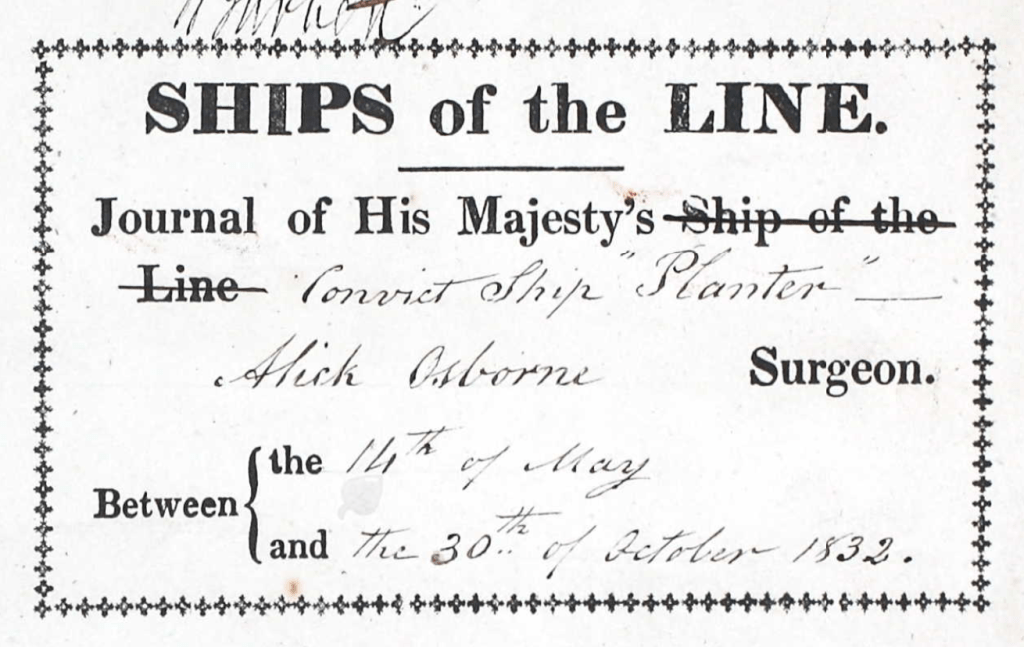
General Remarks
Under this head there is no circumstance worthy of remark, save the remarkable healthy condition of the prisoners through the whole period of the voyage. Slight derangement of the alimentary canal, colds &etc comprise our sick list, and notwithstanding the number embarked was greater in proportion to the size of the ship than have been sent on any former occasion, I have the gratification to state that they were all disembarked in excellent health and condition, not one having even been sent to the hospital on our arrival.
Alick Osborne, Surgeon Royal Navy 1
You can be forgiven for thinking, on the basis of his Royal Navy Journal, that it was an entirely ordinary passage. Boring. Not much worthy of the surgeon’s remarks. Nothing to see. Nothing to tell. Dreary.
But in reality, the entire journey was astonishingly eventful and wholly remarkable.
And how do I know? I know because Alick Osborne kept a separate and detailed personal account of the voyage which he published the following year. 2
I wonder why none of this juicy stuff made its way into his official account…

On embarkation, the prisoners were surprised to find good biscuit, beef, pork, peas, flour, raisins, lemonade, wine, etc. issued to them, in lieu of the coarse brown bread and indifferent beef sometimes supplied by contractors for the hulks.

She finally set sail ten days later than expected and headed out into the ocean. Most of the 200 convicts on board had probably never had their feet in a boat before, might never have seen the sea before, and here they were, completely at sea, no sign of land. What a strange sensation that must have been. It was hardly surprising that seasickness was rife during the early part of the journey.
The convicts have hitherto behaved tolerably well and are now beginning to enjoy themselves after the first brush of sea sickness.
From that point, the onboard routine began. Cleaning, washing, swabbing, winching, schooling, working, mustering… dancing and games.
July 29th. – Crossed the equinoctial line; the weather fine, and climate delightful; the prisoners, basking in the sun, seem to enjoy themselves vastly. We open the prison doors at sun-rise, and they all take their beds on deck, and stow them in the netting, and then bathe (a bathing tub supplied by government,) before breakfast. Some assist in washing decks, wringing swabs, etc.; some turn the winch for the rope-maker, others clean out the prison, some carpentering, shoe-making, tailoring, and employment, if possible, is found for every one. At ten o’clock, boys mustered to school till twelve, and again, when the decks are swept up after dinner, to school from two till four. After four, the decks are cleared up, work ceases, and they entertain and amuse themselves with various Olympic divertisements, tumbling, climbing, and dancing, which are exercise and amusement. On some occasions I have supplied gloves, for sparring exhibitions for an hour or two; and, in addition to the salutary operation of the exercise, I think it tends to dissipate bilious feeling and prevents many petty broils and contentions below.
And it’s all fun and games until someone steals the tobacco…
We have now repeated complaints of petty thieving in the prison at night, stealing bread, tobacco, or any thing to keep the hand in. Sometimes they steal trowsers and blankets, for the purpose of destruction, out of the pure spirit of mischief, aware that they cannot use them, they tear up, and throw them overboard, or into the water closets. Sometimes the culprit is caught in the act, then we punish him with twelve or sixteen hours of solitary confinement on bread and water, and for a second offence, one dozen lashes, which always procures us a respite from all offences for a week or ten days afterwards.
But overall, the convicts on the Planter sound like they were a cheery bunch, optimistically looking forward to the new adventures ahead…
It is astonishing what an elevation of spirits exists with these unfortunates. They are always as cheerful and happy as the day is long… They are all Optimists, and being at the bottom of the wheel, expect every revolution will elevate them in the scale of society; and they mostly indulge in brilliant anticipations of their ultimate success in the colony. I always endeavour to favor the best view of the matter; it inspires confidence, promotes cheerfulness, and exerts a most beneficial influence on their health and conduct during the voyage.
Except, perhaps, during the parts of the voyage when the weather was bad, or the seas were high.
The weather is cold, and nights raw; we have now issued the flannels and warm clothing, which has been carefully hoarded for the occasion; and we now give a gill of wine on alternate days, which has hitherto been given only on Thursdays and Sundays. We have swinging stoves in the prison to dry up any damp and make the place as comfortable as possible; and windsails down day and night, unless it rains, to keep up a constant circulation of fresh pure air.
Ah, Alick, you almost had me thinking that you were a cheerful soul with a sunny disposition.
October 10th. – Entered Bass’ Straits, which separate New Holland from Van Diemen’s Land, with a continuance of favourable winds, and got sight of the coast on the following day. The appearance of the land along the coast is far from attractive and presents the unvaried aspect of solitary sterility; and the brilliant anticipations, the longing for a sight of this land of promise, this Eden of the imagination, (for all have heard some part of the glowing accounts which have been given of Australia,) are dispelled by the gloomy prospects of the drear reality.
From London, the same day, whence she sailed the 16th of June, the ship Planter, Captain Frazer, with 200 male prisoners. Passengers, Lieutenants Bullin and Irvine, of the 38th Regiment; Alexander Osborne, Esq., R. N., Surgeon Superintendent; Mr. Busby; 28 rank and file of the 4th Regiment; 1 sergeant of the 39th; 3 women and 1 child.
Shipping Intelligence. Arrivals., Sydney Gazette, 16 October 1832
The Planter arrived on 15 October and Alick prepared to meet the Governor.
Anchored in Sydney’s Cove on the 16th of October; and the following morning, as in duty bound, waited on his Excellency the Governor, to deliver to him a letter of introduction from a friend in England. The Governor being engaged, I had not the honour of seeing him. Delivered my letter to his private secretary, a young man of pleasing address and genteel deportment, who informed me that it was quite sufficient to put my name in the book, which I complied with, and had not the pleasure of seeing the Governor from that day to this.
The ship’s occupants eventually disembarked on the morning of 29 October 1832. Surgeon and convicts parted ways, and my ancestor John Daines could finally begin his new life in the Eden of his imagination.
 KINdling