Highway Robbery!
I know what you’re thinking. A well-dressed guy on a rearing shiny black horse. He has a menacing-looking scarf covering half of his face. He’s brandishing a pistol and saying to an unsuspecting coachload of terror-stricken ladies – “Stand and deliver! Your money or your life!”
Am I right?
It turns out that highway robbery isn’t what you’re thinking. Not always.
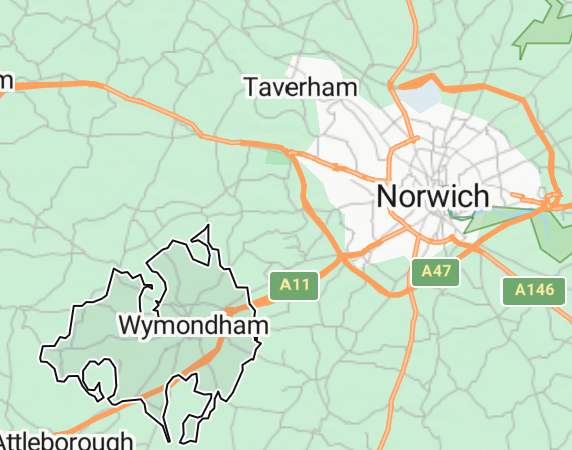
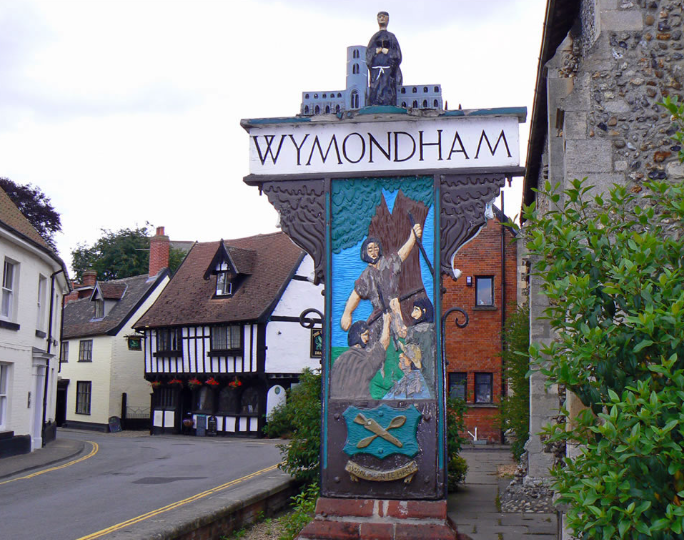
At the Norfolk Lent Assizes on 24 March 1832, John Daines (aged 19, a ‘turner’) with his friends James Poll (aged 24, a groom and weaver) and William Miller (aged 21, a weaver and stableman), were charged with stealing 27 shillings from James Brown on the King’s Highway in Wymondham 1 – a market town on the main road just outside Norwich in the district of Norfolk. The three were each convicted of Highway Robbery.
William Miller had a ‘prior conviction’, John Daines and James Poll had ‘been in custody before’. Although that isn’t great, whatever they had each done previously can’t have been too bad, because those offences didn’t end up with any of them receiving death penalties or being transported. On face value, our three ‘Highway Robbers’ hardly sound like three vicious thugs.
I can’t find much about this particular crime anywhere. Not in newspapers of the day. Not in the criminal records of the three young men. All I can find is the outcome.
So… no rearing horse. No brandished pistol. No coachload of terror-stricken ladies. Just three young men facing a judgement at the Norfolk Assizes, and an unsuspecting non-descript victim who was missing 27 shillings.
My guess is that this was simply a case of three young blokes nicking some shillings off another bloke. Perhaps the truth of it comes down to the criminal system of the day – could it be possible that because it took place in a street classified as a ‘Highway’, the crime was automatically classified as Highway Robbery?
There were nine cases of robbery heard at the same session of the Norfolk Assizes and the outcome was the same for every single one of them. Either the judge was in a bad mood, or a conviction of ‘robbery’ left the judge with one possible sentence that he could apply, and it was applied en masse…
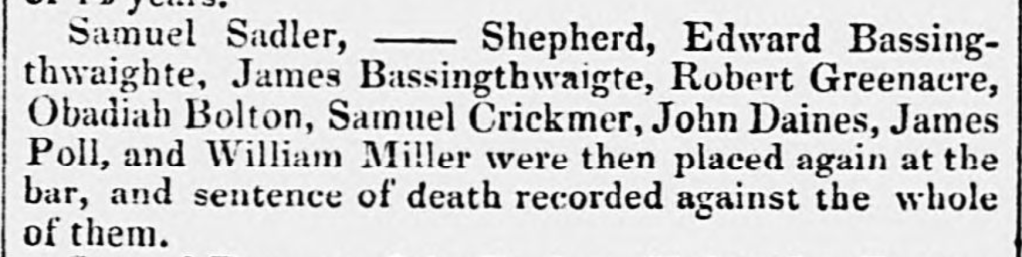
En masse all nine sought a pardon. En masse they were all sentenced to be transported. For Life.
Imagine that.
One moment you’re sentenced to Death, doomed to be hanged. The next moment, intervention. All nine robbers had their sentences commuted to be “transported beyond the seas for the term of their respective lives”. This leniency suggests there were no weapons used, nor any violence in the committing of any of their crimes.
What became of all nine men is not part of this story. My focus, for now, is on our three Highway Robbers, who for the moment were being treated together.
The convict Indent of 1832 is probably the most useful document of all the documents to date. It tells me they were all Protestant. They all had a ‘ruddy’ (healthy reddish) complexion and brown hair, with only their eye colour to tell them apart – until we consider their fuller descriptions.
James Poll was 5feet 3 1/2 inches tall, with a freckled face and brown eyes. He could read and write. He had tattoos; some initials, a child on his lower left arm, blue rings on the middle and fourth fingers of his left hand.
William Miller was 5 feet 6 inches tall, with hazel eyes. He could read. He had irregular teeth and was missing one in the upper front of his jaw. He also had a blue ring tattoo – on the middle finger of his right hand.
John Daines was 5feet 4 1/2 inches tall, with a freckled face and grey to blue eyes. He could neither read nor write. His occupation said turner (good). He was described unflatteringly – a large nose, a declining chin and three moles on his neck. Like his accomplices, John had tattoos; a heart, two darts an anchor and a cable. Just like his friends, he had blue rings on his fingers – on the middle finger of his right hand and the fourth finger of his left hand.
What is with these blue ring tattoos? Was this a sign that our Highway Robbers were more than they seemed, were part of some sinister criminal fraternity? Apparently not. Just as they are today, tattoos of their day were purely decorative. Tattooed rings and other embellishments were an affordable form of jewellery for the working class.2
From the court on 24 March, our Highway Robbers were returned to prison in Norwich. On 30 March they arrived on board the Prison Hulk Leviathan, where they waited until 8 June to be transferred to the cholera-ridden convict ship Planter, under the Royal Navy Surgeon supervision of Alick Osborne, whom you read about in part 1 of John Daines’ story.
And what then for our sinister trio?
You’ll have to wait for Part 3 to find out.
- Norfolk Chronicle 31 Mar 1832, Bury and Suffolk Herald 4 April 1832 ↩︎
- The Digital Panopticon, Convict Tattoos, http://www.digitalpanopticon.org ↩︎
 KINdling