Cold, starving, poor and desperate. A wife and two small children to feed; vagrancy, homelessness, had become a reality.
With diminishing means and the lives of his family in his hands and on his conscious, he stole some oats – 2 1/2 pecks, not a small amount by any man’s standards, but maybe enough so that he wouldn’t need to risk it again until spring.
It was a fool’s folly and it earned him 14 years transportation across the seas, leaving those that he’d meant to help, those whose lives were in his hands, far behind. They were in God’s hands now.
Given the same circumstances, what would you have done? Would you have let them starve?
My 4x great grandfather, James Goodson, spent time on the prison hulk ‘Cumberland’ which was moored in the Thames, before being transferred to the convict ship ‘Larkins’ for the journey to Van Diemen’s Land.
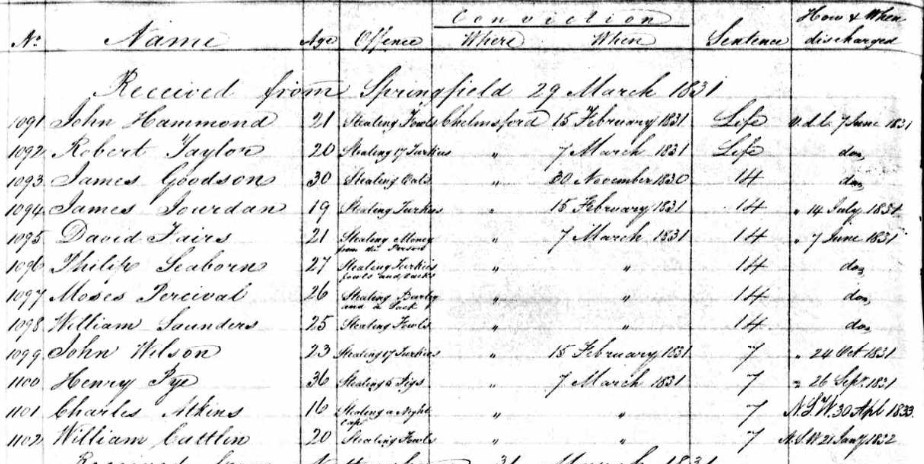
This record is from the ‘Cumberland’, and shows that James and other prisoners arrived on the hulk from Springfield on 29 March 1831. James was sentenced in November the previous year, meaning he’d spent all of the intervening time in Springfield, otherwise known as Chelmsford Prison. James was probably fortunate – Chelmsford was opened in 1825 so it was relatively new and hopefully cleaner than what we imagine when we think of English prisons of the day – but I can’t put my hand on my heart and claim that to be true.
Hulks like the ‘Cumberland’ were decommissioned (and often unseaworthy) ships that were moored in rivers and estuaries, refitted to become floating prisons.
Just being on a hulk was a punishment all by itself. Prisoners kept in the hulks were set to hard labour. Those in hulks on the Thames were put to work improving the navigability of the river by removing gravel and soil from its shores.
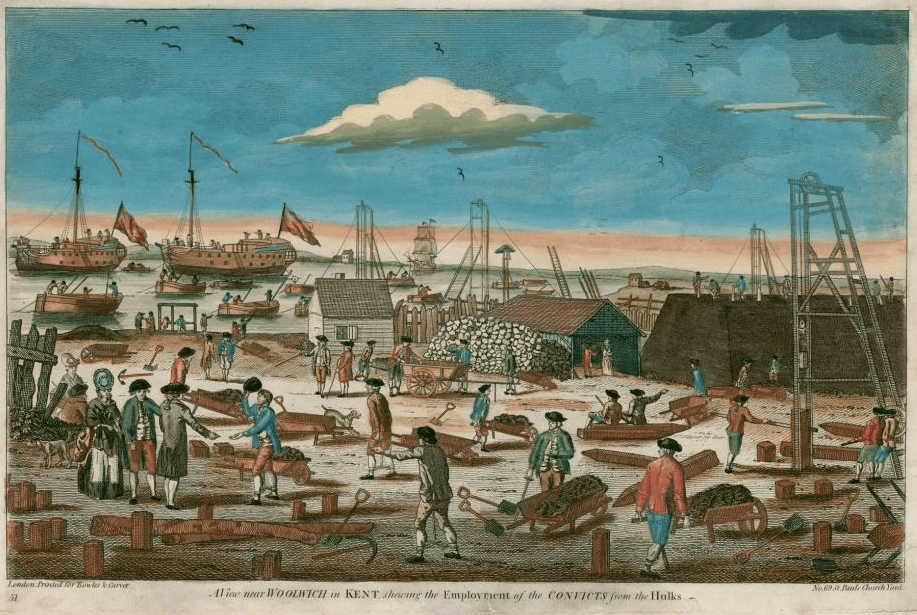
This work was backbreaking, exhausting and very public. This was deliberate; the convict chain gangs were on display, meant to set an example for all who saw them. To make matters worse, the rations were woefully inadequate for the amount of work that was expected and when coupled with the cramped conditions, illness was rife. James was known to be suffering scurvy on board ‘Larkins’, which may have had its origins in his early prison and hulk experiences.
Thirteen years after the theft of the oats, James’ sentence was almost complete when his son (my 3x great grandfather, also called James) broke into a house with some other lads and stole some bread and other items. The burglary earned him ten years transportation across the seas in the same direction as his father, but for James junior the first two years were to be spent on the infamous Norfolk Island.
With the opening of Pentonville Prison and increased use of Millbank Prison from 1843, fewer convicts were sentenced to the hulks, which were increasingly only used for prisoners in poor health and older prisoners. James Goodson junior was in Millbank Prison but I haven’t found any evidence that he spent any time on a hulk before he was transported – a good thing because the punishment on Norfolk Island was going to be more punishment than any man deserved.
The following year, Mary Ann Goodson (my 4x great grandmother) and her daughter Mary Ann junior were charged with stealing a large quantity of linen. Mary Ann senior was a needle woman and I can only imagine she’d intended to sew garments that they could sell. Mary Ann junior was convicted of theft and sentenced to three months in prison but Mary Ann senior was convicted of receiving and sentenced to 10 years transportation, following in the wake of her husband and her son but leaving her daughter and a younger son behind to fend for themselves.
Luckily for Mary Ann Goodson senior, there was only ever one hulk for female prisoners in England – the Dunkirk, which was moored at Portsmouth and was in operation from 1784-1791. From 1844 the hulk ‘Anson’ operated as a female convict probation station in the harbour off Hobart but so far I haven’t found any evidence that Mary Ann Goodson was ever on board.
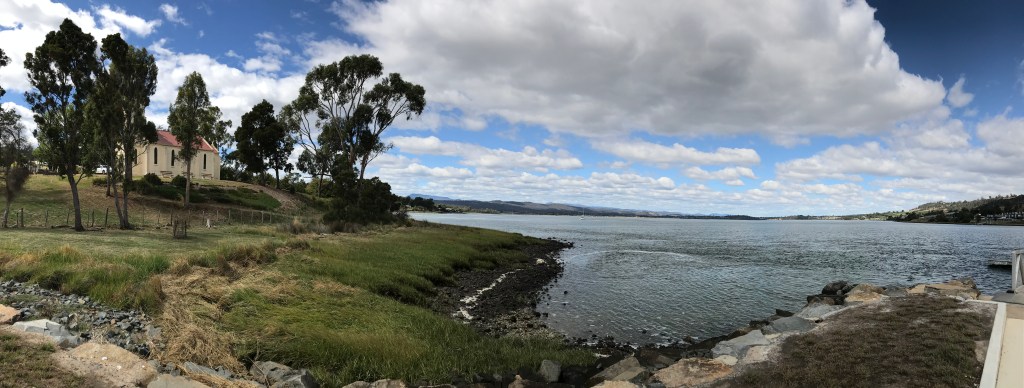
My ancestors went through a lot to earn their freedom and I imagine they must have felt as though they were in heaven when they each arrived in the idyllic village of Windermere, under a crisp blue sky, on the banks of the Tamar River near Launceston in Tasmania. It was a magnificent, fertile and soul-healing place for a once-vagrant Essex family to build a new life.
On the other hand, some of their experiences must have been horrific and hard to overcome. I hope they each were able to put their convict experiences behind them and enjoy the lives that they truly deserved.
 KINdling